Reveal the missing drivers of disease
VirScan™ Exposome identifies past antigen exposures across infection, environment, and microbiome revealing the hidden drivers of immune-mediated disease, phenotypic variation, and immune response.
When immune exposures are unknown, critical disease drivers are missed
In immunology research and drug development, every sample carries a hidden record of lifetime exposure to viruses, allergens, and pathogens. This record is encoded in an individual’s antibody repertoire and reflects both shared and unique immune experiences that shape disease risk and immune response.
Without a comprehensive view of this immune history, it becomes difficult to pinpoint what triggered a response, compare samples across studies, or confidently link exposure to disease mechanisms. Incomplete immune exposure data leads to:
Missed drivers of disease risk
Unexpected immune reactions
Unexplained phenotypic variation
Misleading cohort-level associations
Continued exposure to triggering molecules
Poor separation of correlation and cause
The result?
Opportunities to improve cohort stratification are missed, discovery is slowed by unexpected outcomes, and mechanism-of-disease studies can be misdirected, or the true cause is never identified

Stop guessing. Measure immune exposure.
Until now it has not been possible to assess exposure history and explore it's impact in disease. Through the latest innovation in PhIP-Seq, that is no longer the case. VirScan™ Exposome captures a lifetime record of antigen exposure across infection, environment, and microbiome — in a single high-throughput assay.
What is an immuno-exposome?
The immuno-exposome captures how a person’s immune system has been shaped over time by exposure to non-human antigens — including viruses, bacteria, allergens, foods, microbiome-derived molecules, and biotechnology-related proteins.
By measuring antibody responses, it provides a cumulative view of immune exposure and helps explain why individuals and cohorts can respond differently to the same disease, therapy, or environment.
With immuno-exposome profiling now possible with VirScan Exposome, you can:
Explain different phenotypes in a complex disease
Stratify cohorts based on exposure biology
Anticipate unexpected immune responses
.png?width=758&height=551&name=CDI%20Labs%20Holidays%20IgM%20seasons%20greetings%20(5).png)
VirScan Exposome in action: Comprehensive antigen collection
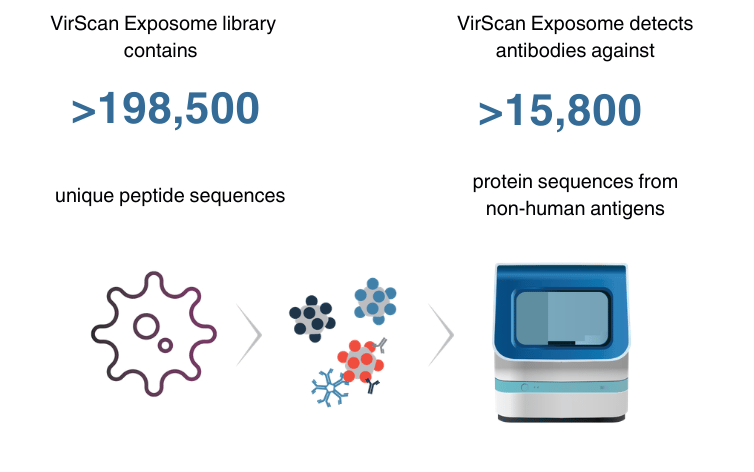
VirScan Exposome PhIP-Seq library is derived from full-length protein antigens of varying origins, as identified by UniProt and the Immune Epitope Database (IEDB*).
Researchers used this novel high-throughput antibody screening approach, to decode the complex history of the antibody repertoire for the first time — enabling exposure profiling across large cohorts without sacrificing resolution.
Why researchers choose VirScan Exposome
VirScan™ Exposome is the first assay available for cohort-scale immune exposure profiling delivering the breadth, resolution, and reproducibility needed for modern immunology.
Unbiased discovery
Interrogate immune exposure signals without pre-selecting targets or limiting your search to known antigens.
Sequence-linked insights
Receive curated, sequence-resolved hit lists mapped to mechanisms, pathways, and immune signatures.
Detect rare targets
Identify low-titre antibodies, rare infectious agents, vaccine epitopes, and novel inducers of autoimmunity.
Broad immune coverage
Profile humoral immune responses across populations, pathogens, and autoimmune conditions.
High-scale throughput
High-throughput, low-input profiling enables rapid screening across large sample sets.
Reproducible across sites
Generate consistent, comparable results across multi-lab studies and collaborative research programs.

CDI Labs: Your partner in proteome-wide binding characterization
CDI Labs is a specialized CRO and lab services company powered by advanced synthetic biology platforms. We have created the largest collection of proteomes and built a team with deep bench experience in proteomics. We partner with research and drug development teams to:
- Decipher molecular interactions across entire proteomes
- Characterize binding, specificity, and immune responses
- Strengthen scientific and commercial outcomes through collaboration and consultation
Ready to uncover the immune exposures shaping your disease of interest?
Partner with CDI Labs to integrate comprehensive immunological response profiling into your discovery workflows using VirScan Exposome — the most reproducible way to decode the cumulative fingerprint of an individual's antigen exposure. Reduce risk, accelerate discovery, and make confident, data-driven decisions.
- *Vita R, Blazeska N, Marrama D; IEDB Curation Team Members; Duesing S, Bennett J, Greenbaum J, De Almeida Mendes M, Mahita J, Wheeler DK, Cantrell JR, Overton JA, Natale DA, Sette A, Peters B. The Immune Epitope Database (IEDB): 2024 update. Nucleic Acids Res. 2025 Jan 6;53(D1):D436-D443. doi: 10.1093/nar/gkae1092. PMID: 39558162; PMCID: PMC11701597.